
Checking for a Warrant in Charleston
Charleston puts no citation or warrant search online. So start at City Hall. Ask the recorder, who doubles as municipal court clerk, where the summons record sits. Bring the date, summons number, or ordinance topic if you know it. Ask whether the city allows inspection, copies, or some other request method under Charleston's own procedure. If the paper names a different city court, call that clerk first. Confirm the summons number or date is enough to pull up any later entry.
- Read the city, court, and summons number on the notice.
- Ask the recorder whether the municipal docket has a later disposition.
- Ask whether a missed appearance led to an ex parte proceeding.
- Confirm current access rules and office hours before traveling.
- For another court’s order, contact that issuing clerk.
Charleston Warrant Search Has No Public Portal
Charleston publishes no online citation or warrant lookup. Neither the city site, its municipal code, nor the UT Municipal Technical Advisory Service directory lists one. That does not erase the court record. It means the public route is a direct question to the recorder, who keeps the municipal court docket. Skip third-party pages promising a complete Charleston warrant list. Ask staff how a case gets identified, whether the record may be inspected, and what form or proof is required. Ask where to submit a request if the counter cannot produce it. Ask how the city replies. The MTAS Charleston directory links the city code and identifies the recorder and judge roles.
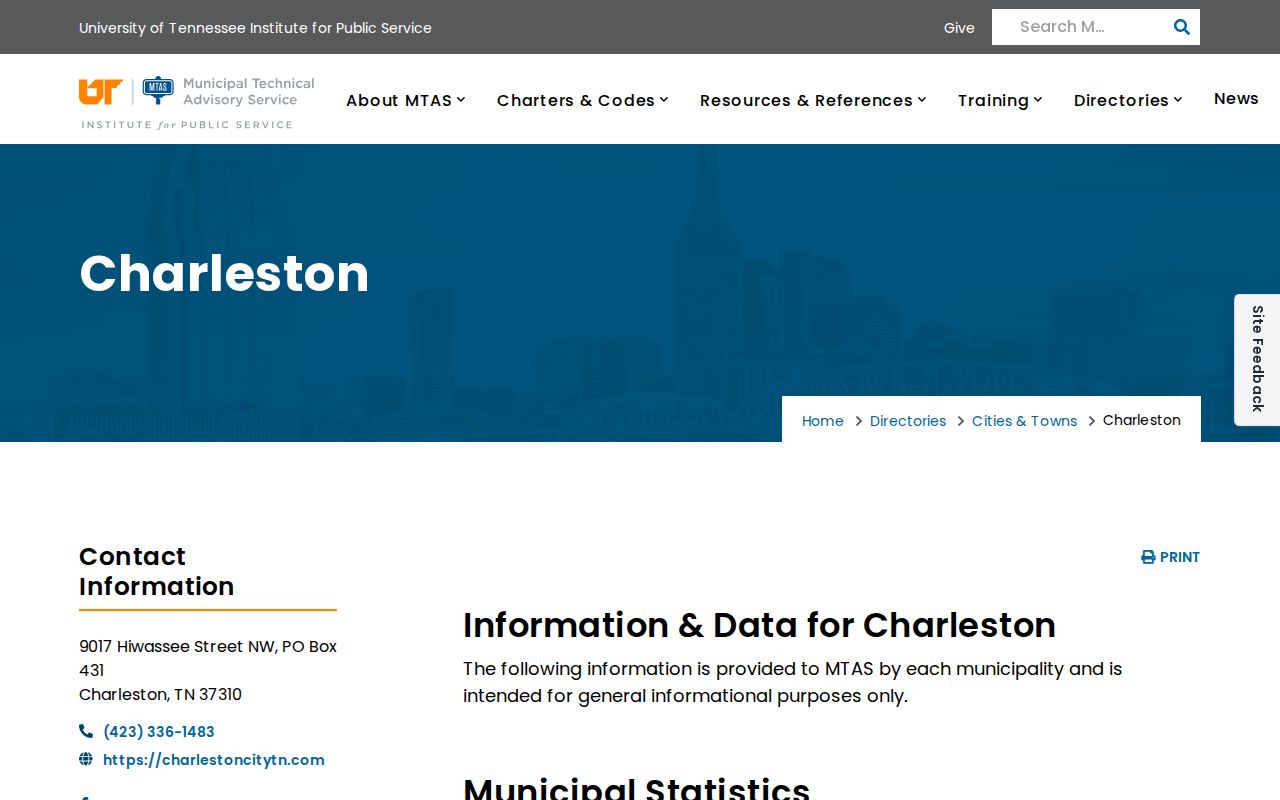
The directory helps identify the city official who can route a record request.
Charleston Police and Municipal Court
Charleston's code names a city judge and a recorder. It posts no searchable police warrant list. No separate police records channel appears either. For a court entry, the recorder remains the safest stop. For a police incident record, ask City Hall who the current records contact is rather than assuming the court holds it.
Charleston City Recorder
City Hall, 9017 Hiwassee Street
Charleston, TN 37310
423-336-1483
Municipal Court
City judge appointed by the board of commissioners
Recorder serves as municipal court clerk
Call Charleston City Hall first to confirm current hours and where a court record can be reviewed.
Charleston Warrant Records Sit with the Recorder
Charleston's Title 3 puts court-record duties on the recorder. The code sketches the docket itself: names, summons numbers, alleged offenses, dispositions, penalties, costs, and collection details. Financial entries appear too. The code lists assessments, suspensions, waivers, transmittals, forfeitures, fines, and fees. So the recorder is the practical first stop for a municipal matter. Ask whether the entry sits in the docket, a financial ledger, or another Charleston record. Ask about copies. Charleston sets its own inspection and duplication procedure, and the recorder's office is not a countywide warrant confirmation service.
Charleston Warrant Types
Charleston's code centers on city ordinance process. A judge may issue a summons. Failure to appear can open an ex parte proceeding and a judgment subject to appeal. No public warrant list appears in the code, and a missed appearance does not by itself prove a warrant exists.
| City record | What it describes | Who can confirm |
|---|---|---|
| Summons | Command to appear on a city ordinance matter | Recorder / court clerk |
| Disposition | Outcome entered in the municipal docket | Recorder |
| Ex parte judgment | Proceeding allowed after nonappearance under Title 3 | City court |
| Appearance bond | Municipal-code process, not county criminal bail | City judge or recorder |
State-law traffic offenses run differently. Use the court named on the citation, and ask whether the matter sits outside ordinary Charleston city process.
Charleston Warrant Process After a Summons
Title 3 lets the Charleston city judge issue an ordinance summons. If the person does not appear, the code allows an ex parte proceeding under city ordinance. The judgment that follows stays subject to an appeal. That is Charleston's process. It is not an automatic warrant rule. Missed a date? Ask the Charleston recorder what the docket shows, what deadline or appeal process applies, and whether a separate warrant was issued rather than assuming one. A lawyer can help if the effect is unclear. In Charleston, the exact title and record matter more than a broad label like "warrant."
Inside a Charleston Warrant Record
The city code sketches a docket schema. It publishes no sample warrant number or searchable record. Ask the Charleston recorder what reference identifies the case and whether a separate warrant entry exists.
| Reference | Ask for the summons number; no public sample warrant format was found. |
|---|---|
| Alleged offense | Ordinance violation listed in the case. |
| Disposition | Outcome or judgment recorded by the court. |
| Financial detail | Costs, collection, fines, fees, waivers, and related entries. |
| Appearance | Summons and any ex parte proceeding after failure to appear. |
| Bond | Municipal code provisions do not establish county criminal bail. |
Charleston Warrant Records: Judge and Recorder
Charleston's board of commissioners appoints the city judge. That judge holds the judicial role the code describes. The recorder serves as court clerk. The clerk keeps the docket and financial records and can explain what is filed and where to request a record, though only the court can make the decision that changes an order. Charleston's appearance-bond, appeal-bond, fine, and cost rules are city-code provisions. They offer no general Bradley County bail amount or Sheriff bond schedule. Ask which amount fits the exact case. Ask who is authorized to receive it, since that line keeps record requests separate from legal decisions in Charleston.
How Charleston Warrants Fit the County System
A Charleston ticket usually starts and stays inside city hall. The municipal court and its city recorder handle Charleston summonses, fines, and dispositions, so that office is your first call. Service can fall to local police or the Sheriff depending on the warrant. County-level charges run through a different door entirely. General Sessions or the Circuit and Criminal Court keeps those files. The Bradley County overview maps each of those separate channels. One caution: a Charleston citation search covers city matters only, and it cannot speak to state, federal, juvenile, or another county's warrants. Know which court issued the warrant before you search.
Charleston Warrant Office Hours and Contact
City Hall sits at 9017 Hiwassee Street, Charleston, Tennessee 37310, and the phone line is 423-336-1483. Posted office hours run Monday through Thursday, 8 a.m. to 2 p.m. Hours shift, so call ahead and ask when the recorder can take your warrant question. A listed fax number, 423-336-6607, appears in city contact material, though Charleston publishes no fax procedure for warrant requests. Confirm how submissions are accepted before you send anything personal. The city's calendar and contact page carries current notices. One more caution: a posted office hour is not a court-session schedule.
Charleston Warrant Context: 2020 and 2025 Counts
How big is Charleston? The 2020 Census counted 664 residents, and a later UT MTAS page puts the 2025 CERT population estimate at 892. Different years, different methods, so the later figure does not replace the Census count. Neither number says anything about warrant activity. Charleston publishes no warrant total or caseload figure, and a small city's records are not automatically merged into the county system. A city summons held by the recorder can still need its own request and its own answer from the court. Ask for a dated court record rather than guessing from population or city size.
Charleston Warrant Records and Public Access
Tennessee's Public Records Act governs access to Charleston's public city records, subject to exceptions. Rule 34 covers court-record access, and some files may be restricted or sealed. Ask the recorder which rule applies to your summons, disposition, or financial entry, and whether inspection or copies are available.
Request clearly: Name the municipal record, approximate date, and summons number if known. Ask about the public-access process and current copy charges.
Do not ask Charleston for a live private-person roster. For a separate county criminal matter, use the county clerk route described above.