
Checking for a Warrant in Bradley County
Figure out which court or agency owns the question before you chase records anywhere else. Tennessee Courts offers a Find Court Clerk directory that points trial-level questions to the clerk where a case began. In Bradley County, that usually means General Sessions Criminal Court, which handles many misdemeanors, traffic matters, preliminary hearings, and warrant questions. Circuit and Criminal Court records run through a different clerk, so confirm the right door first. No countywide search box exists that confirms every warrant. Ask the clerk or Sheriff Judicial Services whether a matter sits in General Sessions, Circuit or Criminal Court, or a city court, and keep a citation or case number handy if you have one.
- Identify the likely court and whether the matter is county, city, juvenile, or federal.
- Call the originating clerk and ask what name, date of birth, or case detail is needed.
- For Sheriff-held records, review the official request rules before sending a TPRA form.
- Check Cleveland’s citation portal only for Cleveland municipal violations.
- If a warrant may exist, ask counsel and the issuing office about safe next steps.
Bradley County Warrant Search Starts at Court
A warrant question is easy to route once you know the likely court. General Sessions is often the first stop for misdemeanor, traffic, and preliminary matters in Bradley County. The Bradley County Circuit and Criminal Court Clerk keeps the higher trial-court criminal filings. Juvenile Court sits apart, and its files have restricted access. If the case began in another Tennessee county, call that county's clerk instead. The state's appellate Public Case History system cannot replace these trial-court records. It may show an appeal, but it offers no Bradley County warrant index. Federal matters go through the Chattanooga Division of the Eastern District of Tennessee or PACER, and sealed records may not appear there. For the full set of county and city routes, follow the Bradley County warrant lookup steps and confirm any possible hit with the office holding the case. The Bradley County Sheriff's official directory lists Judicial Services along with separate court contacts. That page helps with routing, though it is not a live warrant search.
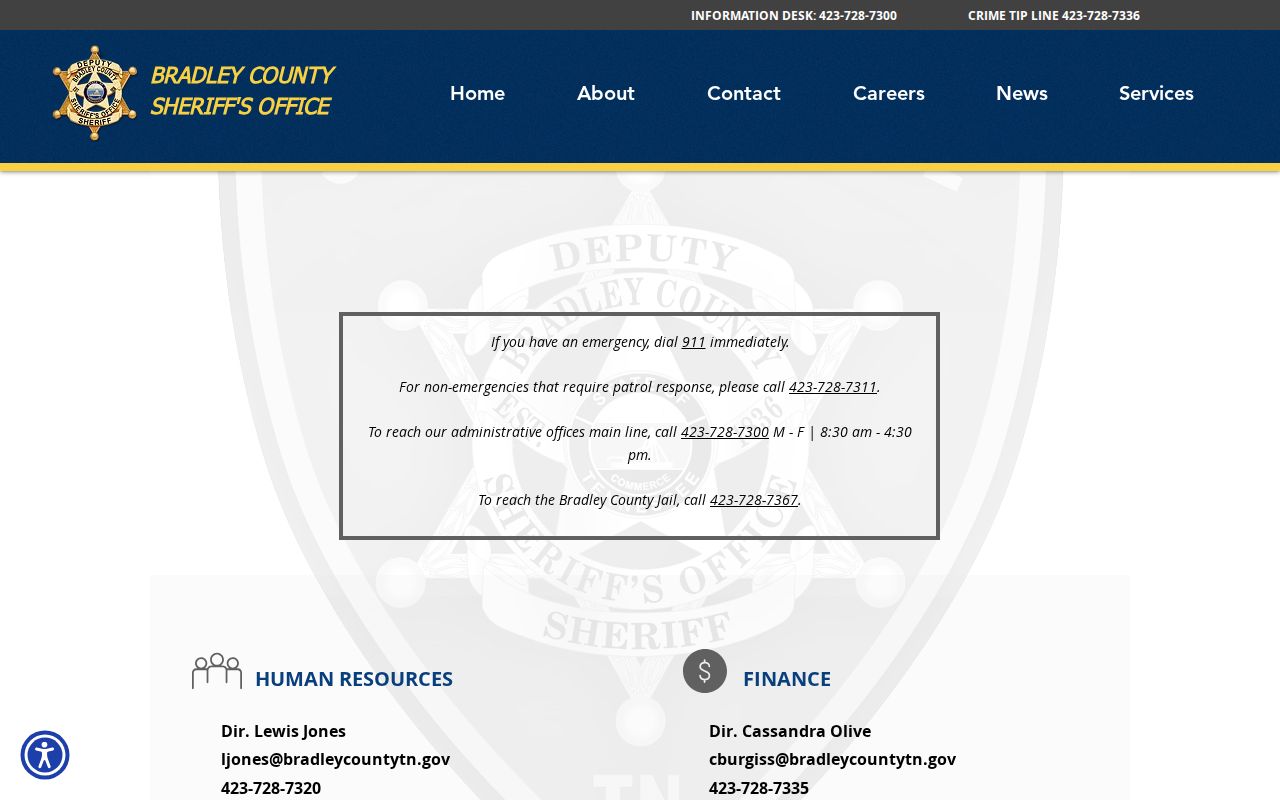
The Bradley County directory also helps you tell who serves process from the clerk who keeps the docket.
Bradley County Warrant Types
Local terms can point to different court actions. An arrest warrant follows a probable-cause process under Tennessee criminal procedure. A bench warrant usually ties to a missed appearance or a failure to comply, though the issuing court decides the actual status. A summons orders someone to appear and is not itself a warrant.
| Record type | How it may arise | Where to verify |
|---|---|---|
| Arrest warrant | Judicial probable-cause process | Issuing court and Sheriff contacts |
| Bench warrant or capias | Possible court nonappearance or noncompliance | Court that set the matter |
| Summons | Order to appear in a case | Clerk’s docket |
| Municipal process | City ordinance or citation matter | City court or recorder |
Don't treat "capias" as its own public search category in Bradley County. Ask the clerk what document the file holds and what step changed its status.
Bradley County City Warrants Use Another Search
Cleveland runs an online Search violations portal for city citations. It takes a citation number, driver's-license details, a Social Security number with date of birth, a vehicle plate and state, or a first and last name with date of birth. Those are alternate citation-identification paths only. They do not make up a Bradley County criminal-warrant or statewide driver-record search. Use sensitive fields only inside the city's secure official portal. A no-result does not prove that no county warrant exists, nor whether a court order followed a missed date. Cleveland's City Court clerk can explain the citation record and the next court step. Charleston works differently. The city posts no public online citation or warrant portal, and its city recorder serves as municipal court clerk, so ask the recorder where a summons, payment, or failure-to-appear record lives.
Inside a Bradley County Warrant Record
Tennessee Rule 4 materials describe warrant and summons records through details like the issuing authority, offense, identity, date, and service return. Bradley County publishes no public warrant-number format or sample active warrant record. Never invent a number or assume every field appears in every court file.
| Case reference | Use the number supplied by the issuing clerk; no countywide format was published. |
|---|---|
| Issuing court | Identifies the judge or court responsible for the process. |
| Offense or reason | Read the exact docket entry and ask the clerk to explain unfamiliar wording. |
| Service or return | A return may record what happened after service; a booking report is not the same record. |
| Current status | Ask whether the order is active, served, recalled, or otherwise changed. |
| Bond | No general Bradley County criminal bond schedule was located. |
If you need proof of recall or satisfaction, ask the Bradley County court clerk for the docket entry or order. A third-party page or old image cannot give you a current court record.
Bradley County Warrant Offices Have Split Addresses
Bradley County splits its court business across several Cleveland addresses, so the first call matters. The Judicial Complex at 2230 Blythe Avenue houses Circuit and Criminal Court, while county pages also list courthouse offices at 155 North Ocoee Street and juvenile criminal offices at 1620 Johnson Boulevard. Cleveland City Court sits in the Municipal Building at 190 Church Street NE, though Thursday court moves to the Police Service Center at 100 Church Street NE. Sheriff administration works out of 2290 Blythe Avenue. Ask which office holds the warrant record, which building takes your appearance, and whether the clerk wants an appointment or identification. Staff can confirm your destination before you drive. One more tip: compare the county clerk’s page with the Tennessee Administrative Office of the Courts directory, since their contact lines differ.
Issuing and Serving Warrants in Bradley County
Judges sign the warrant, the clerk records the file, and deputies serve it. Bradley County splits those jobs across separate offices. The Sheriff's directory lists Judicial Services, Criminal Court, and General Sessions contacts. Ask the clerk about the docket and how to request records; the judge, not the clerk, issued the order.
Bradley County Sheriff’s Office
2290 Blythe Avenue
Cleveland, TN 37311
423-728-7300
County and Sheriff pages show different General Sessions phone numbers. Call ahead and confirm the current desk before trusting either line.
Bradley County Has No Public Warrant List
Bradley County publishes no searchable database of all active warrants. The Sheriff's Most Wanted page shows only a selected roster, and JailTracker booking reports cover custody alone. Neither amounts to a full court warrant list, and Tennessee's appellate tool answers a different question entirely. A blank result online proves nothing about whether a warrant exists. Call the likely clerk or agency directly. For older files, the Sheriff's TPRA request page spells out the requirements for copies.
If You Have a Warrant in Bradley County
Start by finding out which court issued the warrant and whether it is still active. A lawyer can confirm the docket and reach the right clerk. No lawyer? Call the official clerk or Sheriff channel and ask about a safe appearance or surrender procedure before you travel. Bradley County publishes no detailed self-surrender instructions.
Take a careful next step: Speak with an attorney or the issuing court before appearing. Confirm the location, required identification, and current instructions through an official number.
A payment, an old case screen, or a cleared booking record does not recall a warrant. The court may need a separate recall, satisfaction, or return. Ask the Bradley County clerk for that record if you need proof.
Bradley County Sheriff Warrant Records Under TPRA
To request warrant records from the Bradley County Sheriff, Tennessee citizenship comes first. The electronic request instructions also require a signed form, your contact details, a clear description of the record, and a Tennessee photo ID showing a current residential address. Leave the form unsigned, skip the ID, or send an incomplete request, and it may simply go unprocessed. The form promises a response within seven business days: access or copies, a denial citing an exemption, or a written note on when records may be available. Copy or labor charges can apply, and if locating, retrieving, or redacting takes more than one hour, an estimate comes first and work waits for approval and payment. The Sheriff posts no exact fee schedule. Name the court or agency, the record type, and the date range, and say whether you want inspection or a copy. Remember that TPRA is a request process, not an instant warrant status lookup. Court records also follow Tennessee Rule 34 and may be sealed or restricted.
Bradley County Warrant Payment Scams
No law-enforcement agency will call and demand payment over the phone, the Bradley County Sheriff says. A threatening text with a payment link is a scam. Hang up and dial an official number from the agency's own page. For a non-emergency safety concern, the Sheriff lists 423-728-7311. A court-status question belongs with the issuing clerk. Paying a caller never substitutes for a court entry, receipt, or recall order.
Bradley County Warrant Records and Public Access
The Tennessee Public Records Act generally opens government records to Tennessee citizens, with exceptions. Court files also answer to Rule 34, statutes, and sealing orders. Request a record from the office that holds it. No central state repository answers every Bradley County warrant question.
Access limits:
Tennessee Public Records Act, Tenn. Code Ann. § 10-7-503, covers access rules and agency procedures.
Tennessee Rule 34 governs public access to court records and exceptions.
Juvenile records are restricted under Tennessee law, with limited exceptions.
A denial or a missing online result says nothing about whether a Bradley County warrant exists. Ask the records office which rule applies and what, if anything, can be released.
Bradley County Warrant Records Span Separate Courts
Each record answers one question. A booking report covers custody; it cannot show every court action or prove a separate warrant was recalled. An appellate case-history result tracks an appeal, not a new trial-level warrant. Match the record to the court and the stage of the case. Federal matters belong to the Eastern District of Tennessee, Chattanooga Division, and federal docket channels such as PACER. A federal record can be sealed or not yet visible, so a no-result in PACER cannot certify that no federal warrant exists. An empty Bradley County page cannot answer a federal question either. Take federal docket questions to the federal clerk or an attorney. Keep city, county, state, juvenile, and federal searches in their own lanes.
Bradley County Warrants by City
Cleveland (2020 Census: 47,356) offers an online citation portal and a dedicated City Court clerk. Charleston counted 664 residents in 2020, with a 2025 MTAS estimate of 892. Its recorder doubles as municipal court clerk, and the city posts no public citation search.
Cleveland Warrant Search
The portal handles city citations; county criminal matters go to the originating clerk.
Charleston Warrant Search
Ask the recorder about city summonses and dispositions.